An
company | Brands
Compact Nursing Licenses – How Do They Work?
Blog/Compact Nursing Licenses – How Do They Work?
As a travel nurse, you must ensure you can legally practice in the state where your next assignment is located. Many travelers take full advantage of a multistate nursing license to travel freely throughout the U.S. The Nurse Licensure Compact (NLC) includes 43 states in 2026, creating an incredible opportunity for traveler nurses.
Holding an active compact license is the key to unlocking many adventurous career moves. Access more multistate job opportunities and find your next travel nursing adventure with a clear, actionable plan for navigating the NLC, whether your home state is on the list or not.
What Is the Nurse Licensure Compact?
The Nurse Licensure Compact is an agreement between states that allows nurses to travel and work in other states that are part of the compact for travel assignments or extended staff positions. A compact license makes it significantly easier to work in other states without having to obtain additional state licenses.
In the simplest of terms, a compact license is much like a driver's license. It allows a registered nurse (RN) or a licensed practical/vocational nurse (LPN/VN) to hold a single license and practice in multiple states. Many seasoned travel nurses are already aware and taking full advantage of their compact licenses. However, many new travelers wonder how compact nursing licenses work and what steps are needed to travel and work in other states. We're here to provide some clarification on the process.
The Key Benefits of a Compact License for Travel Nurses
The NLC offers major advantages for any nurse looking for career flexibility and exciting new opportunities. Discover the top reasons to apply for your compact nursing license.
Expand Your Job Opportunities
A multistate license gives nurses immediate access to thousands of jobs in all compact states without the wait. If you're looking to expand your career into new territory or take on other opportunities, a compact license is a strategic choice. In addition to multistate access to in-person jobs, a compact license also allows you to provide telenursing services across the country.
Save Time and Money on Licensing
A compact license offers practical savings and financial benefits. Applying for individual state licenses can be costly, with fees that often range from $100 to over $200 per state, plus costs for background checks or verification. Additionally, processing times can take weeks or even months, which can delay your assignments.
Respond Faster to Urgent Needs
When you look at the broader impact of the NLC, it becomes even more essential. It allows for a more mobile and responsive nursing workforce, which is crucial during health crises or in areas with nursing shortages. The NLC allows you to cross state borders quickly and without administrative hassles, making it easier for you to provide vital services in the event of a disaster.
How to Get a Multistate Nursing License
While your state board of nursing manages the licensing process, it usually follows a standard set of requirements.
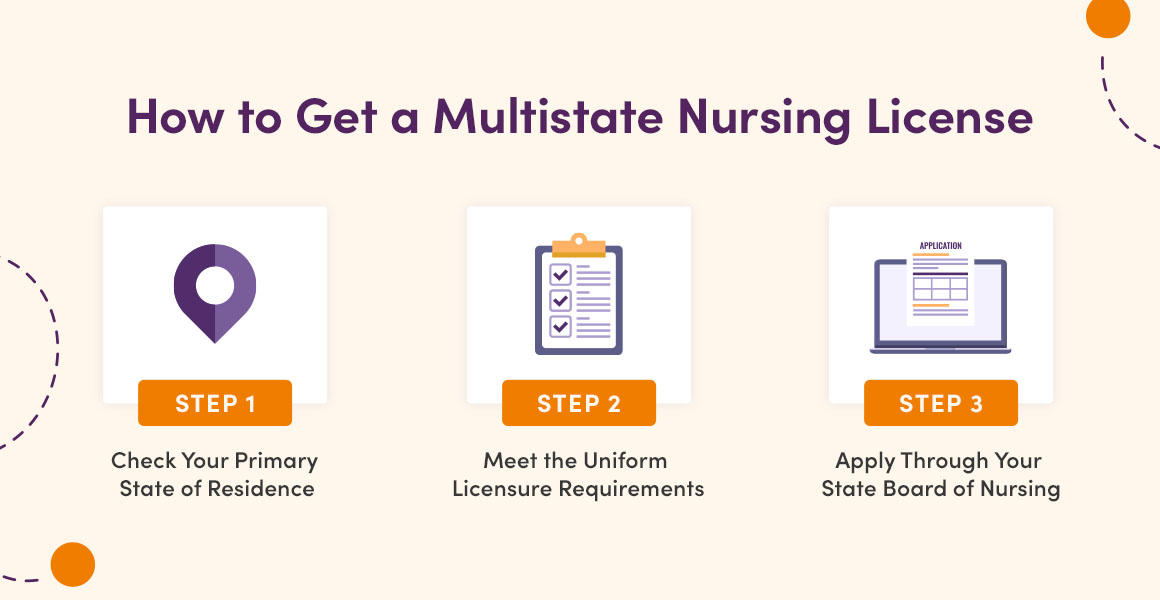
Step 1: Check Your Primary State of Residence (PSOR)
The state you legally reside in is considered your Primary State of Residence (PSOR), and it will determine whether you are eligible to obtain a compact license. This is the state where you vote, pay taxes and hold a driver's license. You can only have one PSOR, and you must live in a compact state to be eligible for a multistate license.
If your PSOR is part of the compact, you may be ready to go. If you met all the requirements when you applied for that license initially, your license would already be compact. If your PSOR became a compact state after you were issued that license, you will need to apply to convert your single-state license into a multistate license.
Step 2: Meet the Uniform Licensure Requirements
The NLC has a few key Uniform Licensure Requirements (ULRs) that you must meet to qualify for a multistate license. The ULRs are a standard set of criteria to ensure that all nurses meet the same minimum qualifications.
The ULRs specify that applicants must have:
Graduated from a board-approved education program
Passed an English proficiency exam
Passed the NCLEX-RN or NCLEX-PN
Undergone state and federal fingerprint-based criminal background checks
Step 3: Apply Through Your State Board of Nursing
The final step is to apply for a multistate license through your home state's board of nursing. If you already have a single-state license in a compact state, you'll likely need to apply to upgrade it to a multistate license. The application process itself takes place at the state level.
If you have any lingering questions about applications, fees or converting your license, your state's board of nursing will have the answers. However, application info from the NCSBN can help provide some direction.
What States Have Compact Nursing License Membership?
The list of states in the Nurse Licensure Compact is subject to change, so the official NLC website is the best source for the most accurate and up-to-date information. Take a look at the current list of NLC member states and pending locations below.
Current NLC Member States
For board information in your state, visit the official NCSBN website. The states that have fully implemented the NLC are:
Alabama
Arizona
Arkansas
Colorado
Connecticut
Delaware
Florida
Georgia
Idaho
Indiana
Iowa
Kansas
Kentucky
Louisiana
Maine
Maryland
Mississippi
Missouri
Montana
Nebraska
New Hampshire
New Jersey
New Mexico
North Carolina
North Dakota
Ohio
Oklahoma
Pennsylvania
Rhode Island
South Carolina
South Dakota
Tennessee
Texas
Utah
Vermont
Virginia
Washington
West Virginia
Wisconsin
Wyoming
Areas With Pending Legislation
A handful of areas have passed legislation but have not yet implemented the NLC or have pending legislation.
States or territories with pending legislation or implementation include:
Alaska
Guam
Hawaii
Illinois
Massachusetts
Michigan
Minnesota
New York
Virgin Islands
What to Do If Your Home State Is Not in the Compact
If your PSOR isn't included in the list of compact states, don't worry — you can still apply for a single-state license in a new state. Many companies offer incentives for nurses to obtain licenses for non-compact states.
The number of states and territories working to join the nursing compact continues to grow, allowing more nurses to practice across many states.
If you have any questions, would like more information or want to apply for a compact license, the NCSBN website is your one-stop resource for any multistate license info.
Start Your Next Adventure With Trustaff
Getting your compact license is a simple and strategic step to expanding your career horizons. Whether you have a compact license or need to get a single-state license, Trustaff is the ideal partner.
We have thousands of jobs at top facilities nationwide and offer a licensure reimbursement program to reward you for your choice. Find your next travel nursing job with the help of Trustaff.